
Why Choose Us?
Rich experience
Founded in 2012, the company is a production and sales company dedicated to optical fiber products. It has its own perfect quality system, product diversification, and its own strong sales group.
Advanced equipment
Coupling aligners, fiber grinders, end face instruments, testing equipment, coupling equipment, packaging equipment.
High quality service
The company actively responds to pre-sale products, solves customer problems, provides feedback for customers during sales, and after-sale quality assurance has always been our top priority.
High quality
The company's product production, quality inspection, sales, export, after-sales and customer service. In the field of optical fiber products, product diversification and product excellence are the foundation of our long-term development.
What Is Optical Fiber Splitter
Optical fiber splitter, also known as a beam splitter, is based on a quartz substrate of an integrated waveguide optical power distribution device, similar to a coaxial cable transmission system. The optical network system uses an optical signal coupled to the branch distribution. The fiber optic splitter is one of the most important passive devices in the optical fiber link. It is an optical fiber tandem device with many input and output terminals, especially applicable to a passive optical network (EPON, GPON, BPON, FTTX, FTTH etc.) to connect the main distribution frame and the terminal equipment and to branch the optical signal.
-

40G 850nm SFP Optical Transceivers
This module features a hot-pluggable electrical interface, low power consumption, and 2-wire serial
Add to Inquiry -
CY have 8years History, at present, We have 2 factory in China, one is in Wuhan of Hubei, another
Add to Inquiry -
CY strictly enforce the ISO9001 quality management system, companies with good facilities and
Add to Inquiry -
Optical Splitter Box 1x64 Cassette SC/APC
This optical splitter use Planer Light wave Circuit (PLC) technology for split ratio 2, 4, 8,16, 32
Add to Inquiry -
Optical Splitter Box 1x32 Cassette SC/APC
Planar lightwave circuit (PLC) splitter is fabricated using silica optical waveguide technology. It
Add to Inquiry -
Optical Splitter Box 1x16 Cassette SC/APC
PLC splitter is a type of optical power management device that is fabricated using silica optical
Add to Inquiry -
Optical Splitter Box 1x8 Cassette SC/APC
Rollball provides whole series of 1xN and 2xN splitter products that are tailored for specific
Add to Inquiry -
Optical Splitter Box 1x4 Cassette SC/APC
Ferrule core is less than 0.5um Adopt 100% new raw material, ROHS compliance Low PDL Compact Design
Add to Inquiry -
Optical Splitter Box 1x2 Cassette SC/APC
PLC splitters are used to distribute or combine optical signals. It is based on planar lightwave
Add to Inquiry -
Optical Splitter Box 1x64 Cassette SC/UPC
This optical splitter use Planer Light wave Circuit (PLC) technology for split ratio 2, 4, 8,16, 32
Add to Inquiry -
Optical Splitter Box 1x32 Cassette SC/UPC
PLC Splitter is responsible to distribute optical signals from Central Office (CO) to multiple
Add to Inquiry -
Optical Splitter Box 1x16 Cassette SC/UPC
Wide operating temperature. Excellent environmental &mechanical stability. Qualified under
Add to Inquiry





How Does Optical Fiber Splitter Work
When the light signal transmits in a single mode fiber, the light energy cannot be entirely concentrated in the fiber core. A small amount of energy will be spread through the cladding of the fiber. That is to say, if two fibers are close enough to each other, the transmitting light in an optical fiber can enter into another optical fiber. Therefore, the reallocation technique of optical signal can be achieved in multiple fibers, which is how fiber splitter comes into being.
The passive optical fiber splitter can split, or separate, an incident light beam into several light beams at a certain ratio. The 1x4 split configuration presented below is the basic structure: separating an incident light beam from a single input fiber cable into four light beams and transmitting them through four individual output fiber cables. For instance, if the input fiber optic cable carries 1000Mbps bandwidth, each user at the end of output fiber cables can use the network with 250Mbps bandwidth.
The optical fiber splitter with 2x64 split configurations is a little bit more complicated than the 1x4 split configurations. There are two input terminals and sixty-four output terminals in the optical fiber splitter in 2x64 split configurations. Its function is to split two incident light beams from two individual input fiber cables into sixty-four light beams and transmit them through sixty-four light individual output fiber cables. With the rapid growth of FTTx worldwide, the requirement for larger split configurations in networks has increased to serve mass subscribers.
Installation and Usage Tips for Optical Fiber Splitters
You can use a splitter on an optical fiber. Optical fiber splitters are devices that allow you to split the optical signal from one source and distribute it to multiple devices. They are commonly used in home theater systems, audio setups, and networking applications.
When using an optical fiber splitter, there are a few installation and usage tips to keep in mind. Firstly, it is important to choose a high-quality splitter that is compatible with your specific optical fiber and devices. This ensures that the signal quality is maintained and there is no loss of audio or data transmission.
During installation, it is crucial to handle the optical fiber and splitter with care. Optical fibers are delicate and can be easily damaged if bent or twisted too much. Make sure to follow the manufacturer's instructions for proper installation and avoid any sharp bends or kinks in the cable.
When connecting the splitter, ensure that it is securely plugged into the optical source and the devices you want to connect. Loose connections can result in signal loss or interruptions. It is also recommended to use short optical fibers between the splitter and the devices to minimize signal degradation.
In terms of usage, it is important to note that optical fiber splitters can potentially introduce some signal loss. This means that if you split the optical signal into multiple devices, each device may receive a slightly weaker signal compared to if it was directly connected to the source. However, with high-quality splitters and short cable lengths, this loss is usually minimal and does not significantly impact the audio or data transmission.
Optical fiber splitters can be used to split the optical signal from one source to multiple devices. Following proper installation and usage tips, such as using high-quality splitters, handling the cables with care, and ensuring secure connections, will help maintain optimal signal quality and performance.
Techniques Enhanced by Optical Fiber Splitters
Some techniques do not inherently need an optical fiber splitter to function but greatly benefit from its inclusion. This is mostly due to the time-saving ability to image multiple different states simultaneously, with other advantages differing depending on the technique. It is important to note that virtually every advanced microscopy application benefits from an optical fiber splitter and the ability to image more flexibly, so the techniques mentioned here are just the tip of the iceberg and this article is by no means exhaustive.
One such technique is resonance energy transfer (FRET), a technique used to determine whether two fluorophores are within a certain distance of each other. FRET takes advantage of the principle of energy transfer between fluorophore molecules: similar to how two magnets will only attract once they are close enough together, two fluorophores will only exchange energy once they are within 1-10 nm of each other. In FRET there are two fluorescent molecules, a donor and an acceptor, if the donor is excited and moves close enough to the acceptor, it will transfer energy. The subsequent decrease in donor fluorescence and increase in acceptor fluorescence can be easily detected by a microscope. This essentially makes FRET a 'spectroscopic ruler' that can measure the distance between molecules, as the reaction only occurs if the fluorophores are within 10 nm of each other.
As there are two fluorophores, the light used to excite them should be at different wavelengths, otherwise, both would be activated at once and FRET would not occur. This means two specific wavelengths are needed to treat both fluorophores, and being able to image two different wavelengths would make this technique faster and more efficient, as it would be instantly clear when one decreases and the other increases in fluorescence intensity. FRET is an excellent technique to make use of an optical fiber splitter.
While all three methods in make use of optical fiber splitters at some point, by using a multiple-camera adapter both fluorophores can be images simultaneously, making this version the fastest and most suitable for live-cell imaging. With no moving parts and no artifacts, simultaneous FRET with an optical fiber splitter device enhances the technique and allows for better experimentation, improving imaging for dynamic processes.
What Applications Are Optical Fiber Splitters Used For
Optical fiber splitters are critical components in today's fiber networks. They're commonly used to connect a central office to terminal equipment and, eventually, to end users in FTTX applications.
There are two key benefits to the use of splitters:
Splitters make networks more scalable
Splitting fiber makes the network flexible and expandable, so the network can grow over time without using up ports or running lots more lines of fiber.
Without splitters, networks would require individual lines for each end-user connection – something that would be difficult to sustain both at a technical level and in terms of the raw costs involved. Splitters allow networks to grow and to serve more users more efficiently.
Splitters increase redundancy
In addition to making networks more scalable, splitters also play a role in making networks more dependable. Specifically, 2:N splitters (splitters with two inputs) are often deployed in a ring configuration to increase physical network redundancy.
Types of Optical Fiber Splitters




The two most common types of optical fiber splitters are FBT (fused biconical taper) and PLC (planar lightwave circuit) splitters:
FBT splitters are made by fusing and stretching two or more fibers together and are relatively simple and inexpensive to manufacture. However, they are limited in terms of the number of splits they can support, typically up to 1:32.
PLC splitters, on the other hand, use a flat waveguide made of silica or other materials to split the signal. They are more complex to manufacture than FBT splitters, but they can support a larger number of splits, typically up to 1:64 or higher. PLC splitters are also more reliable and offer better performance in terms of insertion loss and wavelength uniformity.
Optical fiber splitters come in different shapes and form factors, depending on the specific application and installation requirements. The most common shapes for optical fiber splitters include:
● Box-type splitter
This is a type of splitter that is housed in a rectangular box, typically made of plastic or metal. The box contains the splitter components and is designed to be mounted on a wall or placed in a rack or cabinet.
● Module-type splitter
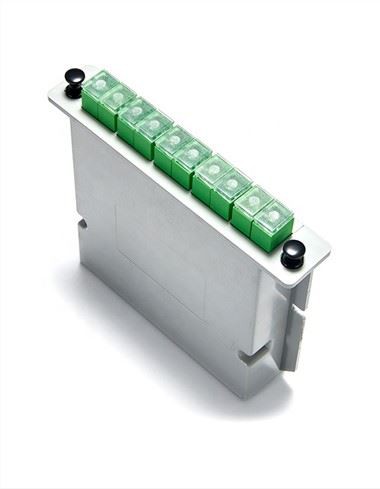
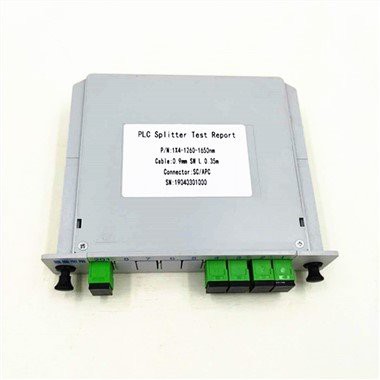
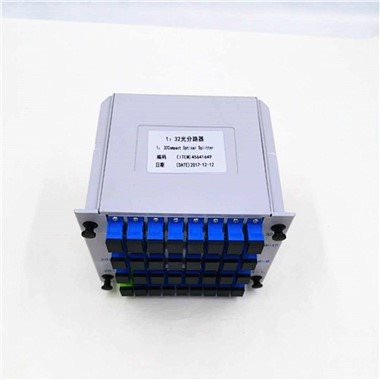
This is a type of splitter that is designed to be installed inside a fiber optic patch panel or enclosure. The splitter components are contained in a module that can be easily inserted or removed from the patch panel or enclosure.
● Bare fiber splitter
This is a type of splitter that does not have an outer protective housing or enclosure. Instead, the splitter components are exposed and are typically spliced directly onto the incoming and outgoing fiber optic cables.
● Rack-mount splitter
This is a type of splitter that is designed to be installed in a standard 19-inch equipment rack. The splitter components are housed in a metal enclosure that can be easily mounted in the rack along with other networking equipment.
● Tube-type splitter
This is a type of splitter that is housed in a cylindrical tube, typically made of plastic or metal. The tube contains the splitter components and is designed to be mounted on a wall or placed in a splice tray.
In addition to these common shapes, there are also specialized types of optical fiber splitters that are designed for specific applications or installation requirements. There are splitters that are designed for outdoor use and are ruggedized to withstand harsh weather conditions, as well as splitters that are designed for use in high-density data centers (plug-in modules) or other environments where space is at a premium.

Optical fiber splitter devices are available in different formats, such as steel tube or ABS box, with common configurations having 2, 4, 8, 16, 32, 64, or 128 outputs.
They feature an SC connector with APC polishing, although other connectors like LC or SCPC can also be found. Additionally, they can be installed in rack cabinets for telecommunications or in internal/external boxes, depending on the characteristics of the existing installations.
In all, there are five steps to manufacture a optical fiber splitter. Each step requires strict control and management of various parameters like environment, temperature, and detailed precision on assembly and equipment.
Step One: Components Preparation
Generally three components are needed. The PLC circuit chip is embedded on a piece of glass wafer, and each end of the glass wafer is polished to ensure highly precise flat surface and high purity. The v-grooves are then grinded onto a glass substrate. A single fiber or multiple ribbon fiber is assembled onto the glass substrate. This assembly is then polished.
Step Two: Alignment
After the preparation of the three components, they are set onto an aligner stage. The input and output fiber array is set on a goniometer stage to align with the PLC chip. Physical alignment between the fiber arrays and the chip is monitored through a continuous power level output from the fiber array.
Step Three: Cure
The assembly is then placed in a UV (ultraviolet) chamber where it will be fully cured at a controlled temperature.
Step Four: Packaging
The bare splitter is aligned and assembled into a metal housing where fiber boots are set on both ends of the assembly. And then a temperature cycling test is needed to ensure the final product condition.
Step Five: Optical Testing
In terms of testing, three important parameters such as insertion loss, uniformity and polarization dependent loss (PDL) are performed on the splitter to ensure compliance to the optical parameters of the manufactured splitter in accordance with the specification.
Our Factory
Founded in 2012, the company is a production and sales company dedicated to optical fiber products. It has its own perfect quality system, product diversification, and its own strong sales group. In the field of optical fiber products, product diversification and product excellence It is the foundation of our long-term development.
The company's product production, quality inspection, sales, export, after-sales and customer service. We strive for perfection, each department does a good job of its responsibilities, the company pursues excellent performance, the work attitude of employees is the key to the company's growth, and they are dedicated and dedicated in their respective positions. The development of the company depends on the hard work of each department. , so that the company can have a qualitative leap.
FAQ
As one of the most professional optical fiber splitter manufacturers and suppliers in China, we're featured by cheap products and good service. Please rest assured to wholesale high quality optical fiber splitter at low price from our factory.
FTTH Terminal Box 12 Core, PLC Splitter, Optical Fast Connector SC APC