
Why Choose Us?
Rich experience
Founded in 2012, the company is a production and sales company dedicated to optical fiber products. It has its own perfect quality system, product diversification, and its own strong sales group.
Advanced equipment
Coupling aligners, fiber grinders, end face instruments, testing equipment, coupling equipment, packaging equipment.
High quality service
The company actively responds to pre-sale products, solves customer problems, provides feedback for customers during sales, and after-sale quality assurance has always been our top priority.
High quality
The company's product production, quality inspection, sales, export, after-sales and customer service. In the field of optical fiber products, product diversification and product excellence are the foundation of our long-term development.
What Is Optical Fast Connector
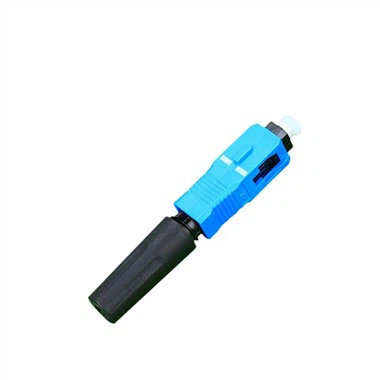
Optical fast connector is a type of fiber connector designed to quickly and conveniently terminate fiber optic cables.
Optical fast connector is also called quick connector, field-assembled fiber optical active connector. It is a reusable and removable passive optical device, mainly used for the connection between optical fibers and fiber optical equipment. It is currently the most widely used passive optical device. According to different installation structures, it can be divided into : Mechanical connection type and hot melt type. The structure of the fast connector consists of three parts: The main body, the shell and the tail cap.
-

Hot Melt SC/APC Fast Connector
1. FTTH project usable. 2. Field installable. 3. Insert loss less than 0.3dB. 4. Metal V-shape
Add to Inquiry -
1. FTTH project usable. 2. Field installable. 3. Insert loss less than 0.3dB. 4. Metal V-shape
Add to Inquiry -
FTTH Optic Fast Connector SC/UPC
A fiber optic quick connector terminates the end of an optical fiber, and enables quicker
Add to Inquiry -
1. FTTH project usable. 2. Field installable. 3. Insert loss less than 0.3dB. 4. Metal V-shape
Add to Inquiry -
Fiber Optic Mechanical Connector designed for FTTH is a new generation of fiber connector used in
Add to Inquiry -
FTTH Optic Quick Connector SC/UPC
The Fast Connector (Field Assembly Connector or Field terminated fiber connector, quickly assembly
Add to Inquiry -
CY strictly enforce the ISO9001 quality management system, companies with good facilities and
Add to Inquiry -
Utilizing these pre-polished, no epoxy fiber connectors to save money & time. Powerlink supply
Add to Inquiry -
Installed in order to ensure the quality and efficiency of research and development of the high
Add to Inquiry -
The Fast Connector (Field Assembly Connector or Field terminated fiber connector, quickly assembly
Add to Inquiry -
FTTH Optic Fast Connector SC/APC
The Fast Connector (Field Assembly Connector or Field terminated fiber connector, quickly assembly
Add to Inquiry -
The Fast Connector (Field Assembly Connector or Field terminated fiber connector, quickly assembly
Add to Inquiry




What Are the Types of Optical Fast Connectors
Optical fast connectors differ based on what types of cables they connect. For example, single-mode fiber connectors and multimode fiber connectors each pair with the cable with the same mode compatibility.
With many electronics that require fiber optic connections, several types of terminations exist. The most common fiber connectors are LC and SC. SC and LC connector types are so common that many systems have designs to accommodate them. What are the different types of fiber connectors? They are as follows:
Lucent Connectors (LC)
LC connectors have some of the smallest ferrules, measuring 1 1/4 mm, which is approximately half the size of an ST connector. Their tiny size puts them into the small form factor category of terminations. These connectors work well for multimode transceivers and single-mode cables.
Standard Connectors (SC)
SC connectors have a 2 1/2 mm ferrule that snaps cleanly into place. Using a push and pull motion secures the connector. These types of terminations have high levels of performance, which along with a price drop since their introduction, has contributed to their vast popularity in multiple applications. In fact, many formerly ST connectors applications now use SC connectors instead, since SC was invented to supplant ST in both telecommunications and data communications.
ST Connectors
ST connectors are among the oldest of fiber cable connector types. Until 2005, this proprietary AT&T brand of connector ranked as one of the most popular fiber terminations. While solutions that solve some issues ST connectors present have replaced these connectors, they still remain popular. Today, their cost is low due to their age, making them a choice for budget-mindful projects.
The design of ST connectors is a 2 1/2 mm ferrule that has a bayonet-style connection between the fibers through an adapter. These ferrules use a spring-load design that can make installation difficult unless the parts have precise seating, though a keyed slot assists with aligning the ferrules for connection.
Ferrule Core (FC) Connectors
FC connectors rank as some of the most popular for use with single-mode connections before the introduction of LC and SC connectors. These use a keyed, screw-in type ferrule. However, the process of screwing in the ferrule requires extra time and effort compared to snap-in SC connectors.
The screw-in design prevents the connection from interruptions, even when someone pulls the cable or the system has applications in areas with a lot of movement. Video over fiber is one use for these types of connectors due to the constant flow of data through the cable and the security of the connector.
Like ST and SC connectors, FC terminations use a 2 1/2 mm ferrule. With a hybrid adapter, anyone can create a bridge between these connector types.
Multi-Position Optical (MPO) Connectors
MTP is the commercial brand of MPO connectors. MTP and MPO connectors are the same, except the MTP brand has a specific use for high-performance applications, whereas MPO works on more mechanical situations. These two connectors usually connect ribbon cables with multiple fibers.
These connectors have two to six rows of 12 or 16 fibers. MPO connectors with 12 fibers per row can have two to six rows, with two the most common number. Connectors that have 16 fibers per row do not have more than two rows. Connections between ferrules use pins and holes to mate the ends of the fiber with another cable or an electronic device. Most often, this type of connector has applications in either high-speed links that use multimode or for pre-terminated cable groupings.
MT-RJ Connectors
MT-RJ connectors have disappeared from use. However, some systems may still require these connectors for repairs. MT-RJ only works for multimode cables with duplex fibers. Both fibers go into the ferrule that connects to its mated half with pins and holes, similar to MPO terminations. Some plug-and-jack variations on this type of connector also exist.
Optical Fast Connector Advantages
Reliability and efficiency
The optical fast connector stands out for its unparalleled reliability and efficiency in ensuring seamless connectivity within fiber optic systems. This reliability is attributed to the robust design and construction of the connector, which are engineered to maintain consistent performance even in demanding environments.
With a focus on efficiency, optical fast connectors are optimized to minimize signal loss and ensure the swift transmission of data across fiber optic cables, making them a preferred choice for high-performance networking and telecommunications applications.
Ease of use
One of the key advantages of optical fast connectors lies in their user-friendly design, which simplifies the installation process and enhances overall usability. This ease of use makes them well-suited for various applications where swift deployment and reliable connectivity are paramount.
The simplicity of optical fast connectors not only streamlines installation procedures but also contributes to their practicality, especially in scenarios where rapid deployment or reconfiguration of fiber optic connections is required.
By incorporating these advantages, optical fast connectors significantly contribute to the seamless integration and performance optimization of fiber optic technology.

Step 1: Remove the connector tail cover and pass the cable through.
Step 2: Use a fiber optic stripper to peel off the cable sheath to a length of about 5cm.
Step 3: Use Miller pliers to remove the cable sheath. Cut off the exposed coating on the edge of the clamp to expose the optical fiber.
Step 4: Wipe and clean the exposed optical fiber with a dust-proof cloth.
Step 5: Cut the optical fiber with the clamp.
Step 6: Align the optical fiber with the main body hole and insert it. When the optical fiber is initially in When in the bending state, the crimping cover is pressed down.
Step 7: Screw the tail cover on the string cable back to the connector body and tighten the shell.
Best Use Cases for Each Optical Fast Connector Connection Type
LC Fiber Connector Use Cases
● Data centers
● Enterprise networks
● Fiber-to-desk applications
● Medical and industrial equipment
● High-speed internet and telecommunications
SC Fiber Connector Use Cases
● Telecommunication networks
● Internet service providers
● Cable television
● Military communications
● Industrial equipment
ST Fiber Connector Use Cases
● Legacy networks
● Industrial equipment
● Military communications
● Cable television
● Local area networks (LANs)
FC Fiber Connector Use Cases
● Storage area networks (SANs)
● High-performance computing
● Data centers
● Industrial equipment
● Military communications
MPO Fiber Connector Use Cases
● Data centers
● High-performance computing
● Telecommunication networks
● Parallel optics transceivers
● High-speed internet and telecommunications
MT-RJ Fiber Connector Use Cases
● Data centers
● High-performance computing
● Telecommunication networks
● Parallel optics transceivers
● High-speed internet and telecommunications
Step 1: Know the fiber count and connector type
Choose the connector type based on your existing equipment and long-term plans. Select the LC connector if you are using the most common SFP module. You may choose an MPO or LC connector. SC and LC are the most common choices, MPO is for high throughput data centers, and VSSF connectors such as CS and SN are for 400G and beyond fiber cabling applications.
Step 2: Know the fiber type
Like fiber cable, fiber optic connectors can be commonly categorized into single mode and multimode. Single mode fiber permits one light mode to propagate simultaneously, offering the longest transmission distance. The multimode allows many light modes to propagate through the fiber, supporting a very short distance but lowering cabling costs.
Those fiber connectors usually have different color codes for easy identification. Single mode connectors typically have blue or green covers, while OM1/OM2 multimode connectors have beige covers, OM3 has aqua color, and OM4 with magenta color.
Step 3: Know the polish type
Remember the Polish type. Fiber optic connectors are available in PC, UPC, and APC polish. Different polish offers performance and cost difference.
Cable diameter: This refers to the maximum fiber optic cable diameter allowed for the connector.
Insertion loss: Insertion loss refers to the amount of optical power lost when the light passes through the connector. Typically reported in decibels (dB). Typical values of are in the order of 0.5 dB. It is given by.
InsertionLoss=−10log(Pout/Pin)
Where insertion loss is typically in dB, Pout is the output optical power, Pin is the input optical power.
Return Loss: Return loss also known as reflectance, is the loss of optical power that occurs when light is reflected back towards the source at an optical component's interface. Return loss is typically expressed as the magnitude of the reflected signal. Return loss can apply to all fiber optic components including couplers, splitters, splicers, connectors and attenuators.
ReturnLoss=−10log(P0/P1)
Where return loss is typically in dB, P0 represents the reflected optical power, and P1 represents the input optical power. Learn more about optical loss and attenuation here.

Maintenance of Optical Fast Connectors
Maintenance of optical fast connectors is crucial to ensure optimal performance and reliability of fiber optic networks. Regular maintenance helps prevent signal loss, connection issues, and other potential problems that may arise.
To maintain optical fast connectors, it is important to clean the connectors regularly using specialized cleaning tools and solutions to remove dust, dirt, and other contaminants that can affect signal transmission. Inspecting the connectors for any signs of damage or wear is also important, as damaged connectors can lead to performance issues.
Additionally, checking the tightness of the connectors and ensuring proper alignment is essential for maintaining a strong and stable connection. Regular testing of the connectors using optical power meters and OTDRs can help identify any potential issues early on and prevent network downtime.
With the latest advancements in fiber optic technology, maintenance of optical fast connectors may also involve using automated cleaning systems and inspection tools to streamline the maintenance process and improve efficiency. Adapting to these new technologies can help network operators ensure the reliability and performance of their fiber optic networks in the long run.
Our Factory
Founded in 2012, the company is a production and sales company dedicated to optical fiber products. It has its own perfect quality system, product diversification, and its own strong sales group. In the field of optical fiber products, product diversification and product excellence It is the foundation of our long-term development.
The company's product production, quality inspection, sales, export, after-sales and customer service. We strive for perfection, each department does a good job of its responsibilities, the company pursues excellent performance, the work attitude of employees is the key to the company's growth, and they are dedicated and dedicated in their respective positions. The development of the company depends on the hard work of each department. , so that the company can have a qualitative leap.
FAQ
As one of the most professional optical fast connector manufacturers and suppliers in China, we're featured by cheap products and good service. Please rest assured to wholesale high quality optical fast connector at low price from our factory.
Optical Fast Connector, PLC Splitter 1x4 Mini Type, Optical Splitter Box 1x4 Cassette SC APC